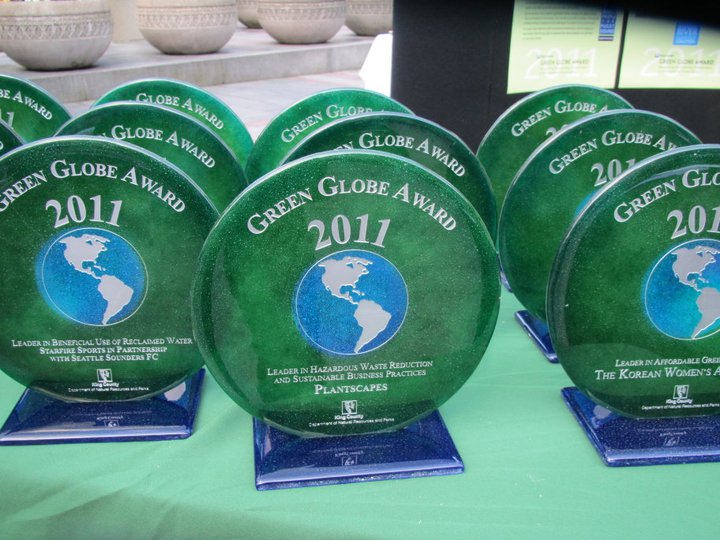
King County has honored Plantscapes as a Leader in Hazardous Waste Reduction and Sustainable Business Practices with a 2011 Green Globe Award.
The text of the award reads:
“Providing services throughout Seattle for over 40 years, Plantscapes offers interior and exterior landscape management. Plantscapes works primarily with commercial properties, homeowner associations, and multi-family properties.
“They have earned the highest 5-Star certification from the EnviroStars Program by choosing the least toxic, most environmentally sensitive options available for every job, and spreading best practices through Green Gardening workshops and the Washington Association of Landscape Professionals.”
Plantscapes has long been a leader in environmentally friendly landscape practices. Our employees have adopted traffic circles – weeding, planting, and beautifying the neighborhood. They join community organizations like Master Gardeners, Master Composters, Plant Amnesty, the Association of Women in Landscaping, and Seattle Tilth. Plantscapes employees are passionate about gardening and the environment – so we are particularly proud to receive this recognition.
Congratulations to Azure Allender and Kathie Madsen who have spearheaded so many of our environmental efforts in the past year.
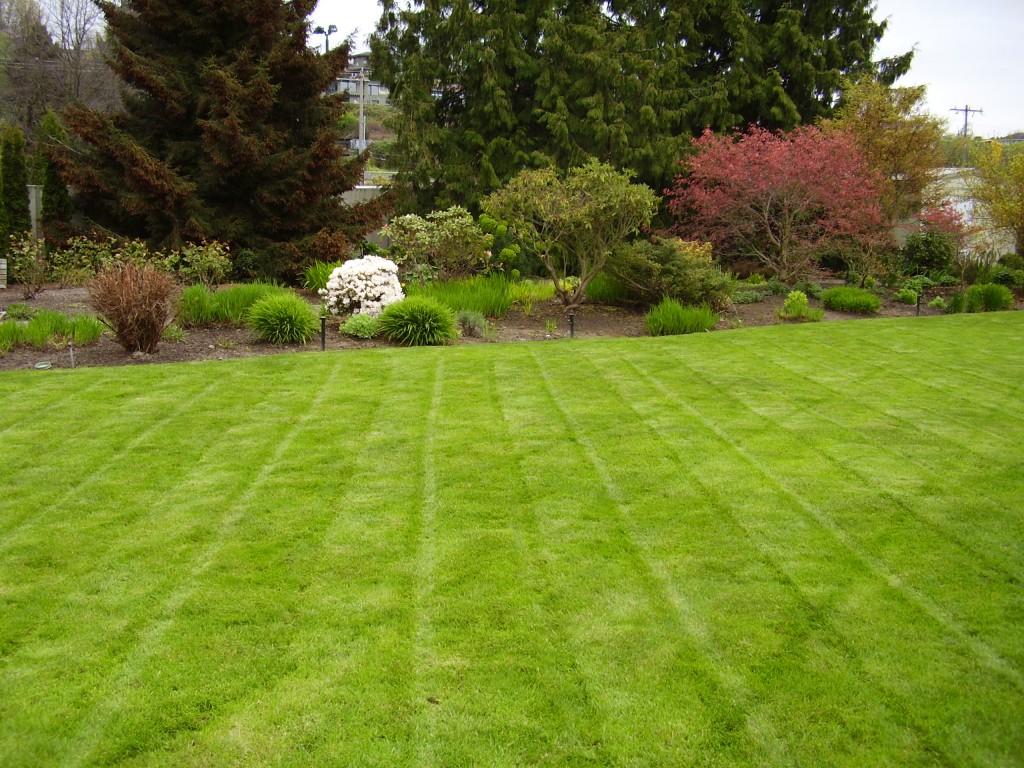
As the weather warms up, more people head outside to catch every moment of sun. In the Northwest, that means sitting on the grass during lunch, on coffee breaks – whenever you can catch a few minutes to enjoy the new flowers and the change of season. While March remains a little dreary and overcast, it is the perfect time to renew your turf.
Keeping grass lush, green and inviting isn’t that difficult – especially in the spring when rain still supplies plenty of water. There are a few essential steps, however:
(1) Aerate your turf. This simple process involves pulling plugs from the ground to break up compact soil and to allow air to circulate freely. It can be done mechanically on large areas or with manual equipment in small spaces.
(2) Fertilize. A good quality fertilizer will send roots deep into the earth – insuring that top growth is strong and thick. A rough rule of thumb says the roots of your grass should be at least as deep as the grass is tall. Which means – don’t mow the grass so that it is golf course short. One to two inch tall grass still looks neat on top of the soil, while the invisible roots hold moisture and fertilizer to keep the blades green and growing.
(3) Add lime as needed. Northwest soils tend to be more acidic – so it is generally a good idea to test the pH and add lime to your fertilizer mix. A pH of 6.5 is ideal.
(4) Thatch. Thatching can make your turf look chopped up and messy – so it is best to do it when the grass will fill back in quickly (right about now is a good time!) Thatching pulls out old, dead grass and allows room for new growth to take root and thrive.
(5) Overseed. Fill in bare patches before weeds do – overseed with a good quality lawn seed. Use seed suited to your area and climate. In the Puget Sound area, fescues do well in shady areas and rye grass mixes do well in full sun. Rye grass is also hardy and can take a fair amount of trampling – so it is good for heavily trafficked areas. In general, bluegrass, although pretty, grows poorly in the northwest. If you use a seed mix with bluegrass seed, keep the percentage of bluegrass below 20%.
(6) Mulch flower beds. Remove your old bark mulch, where weed seeds and disease may be hiding, and add fresh mulch for the spring. It looks and smells great, and it keeps weeds from sprouting. A thick layer of mulch is one of the best investments you can make it your landscape. It will reduce labor, save water, and suppress weeds – and all you have to do is replenish it annually.
GREEN GRASS IS “GREEN,” TOO
Sometimes, when we talk to clients about turf, we get questions about the “bad” effects grass can have on the environment: fertilizer run off, wasted water, constant mowing etc. But consider – each of these problems is actually caused by poorly cared for turf. A well managed lawn enhances the environment in important ways:
Well-cared-for lawns can significantly increase your property values.
A healthy lawn is of utmost importance to our environment. A 50-foot by 50-foot lawn produces enough oxygen for a family of four.
Lawns cool the atmosphere. Eight healthy front lawns have the cooling effect of 70 tons of air conditioning, which is enough for 16 average homes.
Grass converts carbon dioxide to oxygen, a process that helps clear the air.
Dense, healthy grass slows water runoff, removing contaminants and trapping soil. Fresh, filtered water returns to the underground water supply.
If you haven’t yet subscribed to Plantscapes’ Spring Turf program, give your customer service rep a call.
Organic gardening – or at least, organic fertilizer – appeals to most vegetable gardeners. In fact, one of the chief reasons for growing vegetables is to have a ready supply of healthy, natural food right outside your door.
But for the vegan (or any type of vegetarian) gardener, the ingredients in a balanced organic fertilizer may be even more of a horror than those found at the local garden center.
What’s the solution? Mix your own vegan organic fertilizer!
It is easy and inexpensive if you buy in bulk.
Let’s look at the mixing formula first – then we can look at each component. This formula is adapted from Steve Solomon’s Complete Organic Fertilizer and from the Vegan Organic Mix recommended by The Garden Shed in the 1990’s.
VEGAN ORGANIC FERTILIZER
2 parts screened worm castings or compost
4 parts “fast” release nitrogen derived from plants (soybean meal, alfalfa meal, cottonseed meal)
1/2 part slow release phosphorus – derived from minerals (soft rock phosphate)
1 part “fast” release potassium derived from plant material (north sea kelp meal)
1/2 part “slow” release potassium dervived from minerals (greensand)
1/2 part trace minerals (crushed rock/ Rado Rock/ granite meal)
For outdoor beds, add well rotted compost to the planting area at a rate of 1 cubic foot per 10 square feet.
I try to include more than one source for each macronutrient (N-P-K). This can help balance the release times of the fertilizer and keep it working all season. Of course,”quick” and “slow” are relative terms since most organic fertilizers are not water soluable.
And here’s the beauty of organic fertilizers – we are trying to achieve a balanced mix that will feed the soil, not a chemical formula that can pass the Department of Ag inspector’s test. If you know your soil will benefit from a little more kelp and compost – add them! Building healthy soil is an ongoing process requiring observation and trial and error.
This recipe is by volume – as long as you use the same measure for each ingredient, you’ll be OK. I use it at the rate of approximately 5 lbs per 100 sqare feet – but I had to find a scale and weigh my bucket to determine that. Adding this type of fertilizer by volume (i.e., this pail size for this bed) rather than by weight is perfectly safe.
INGREDIENTS
Start with Nitrogen. Nitrogen is essential for leafy, green growth. It is also one of the most soluable fertilizer components. In organic fertilizers, nitrogen is introduced either through decomposing plant material (like alfalfa meal) or through a slaughterhouse by-product like blood meal.
You already know we’ll pass on the bloodmeal, so which plant source is best? I like to use alfalfa meal, if I can find a trusted source. (Down To Earth from Eugene, Oregon sells a high quality alfalfa meal.) Don’t use the alfalfa sold as rabbit pellets. It has probably been sprayed with chemical pesticides. By the same token, also be wary of alfalfa meal sold as a rose fertilizer. Rose growers are not necessarily organic growers.
Alfalfa has many benefits besides its nitrogen content. Earthworms are attracted to it – and there are few gardeners as talented as earthworms when it comes to building healthy soil. Alfalfa is also an excellent bio-activator for compost.
Soy meal is another high quality source of nitrogen. You can combine alfalfa meal and soybean meal to give variety to your nutrients.
Cottonseed meal has lately fallen out of favor with organic growers since cotton is so heavily sprayed with pesticides. According to most experts, the pesticides themselves are mainly trapped in the cottonseed oil, rather than the meal, so cottonseed meal should be safe for use in organic gardens. However, organic growers have been registering their displeasure at the level of pesticide use by avoiding cottonseed meal.
There aren’t many non-animal sources of Phosphorous. Once we drop bonemeal and fishmeal from the list, we are prettyt much limited to rock phosphate. Rock Phosphate can be an excellent fertilizer, and it should be worked into the soil of every garden. However, be aware that it may take several seasons to break down completely. If you can mix Hard Rock Phosphate and Soft Rock Phosphate together, you may have a more balanced fertilizer. Talk to your supplier about the source of the rock phosphate. It may be contaminated with other mining waste you want to avoid.
Potassium (or potash) can be readily found in both slow mineral and fast release plant form.
The #1 source for potash is nature’s miracle plant – kelp. Don’t skimp on the kelp meal. It is not always necessary to buy the highest quality, most expensive, North Sea Kelp Meal – but you do want your kelp to come from a known source.
Your retailer should know something about the origin of the product. Try not to buy kelp that comes from endangered kelp beds. Stay away from kelp that was harvested from harbors and shipping lanes: it is likely to be contaminated with diesel, at a minimum.
If you can’t afford Norwegian Kelp Meal, look for a good quality Asian Kelp Meal. You might find it for half the price of the Norwegian Kelp – with no noticeable compromise in results.
Kelp Meal is going to give your plants a ready source of potassium, for general, robust health. It also supplies abundant micronutrients and minerals for the microbial life in your soil. Without a doubt, a generous helping of kelp is one of the best things you can add to your soil.
For a slow release potassium – and slow in this case means years – try greensand. This seabed mineral not only supplies potash and micronutrients, it helps break up compaction in heavy clay soil and it absorbs moisture, reducing the need to water.
You may or may not have to add lime to your soil. This can vary from plot to plot in the same garden – and can certainly vary with the different requirements of different plants. You can test your soil pH with an inexpensive kit before adding lime.
Your final ingredient is rock dust. Most people don’t think of rocks as fertilizer – but they are the best source of minerals for organic gardens. Of course, you can’t just toss in some stones and call it good. You want finely ground – in fact, ground to dust – rock with a high mineral content. Granite dust is good. Glacial rock dust is excellent. As always – be responsible with your sourcing. Do not damage the natural environment to improve your own little plot of land.
That’s it. All these ingredients (with the debateable exception of worm castings, which you can skip) are animal-by- product-free fertilizers and minerals, acceptable to vegetarians of every stripe. Each adds something unique to the soil structure. Microbes, worms, and other life in your soil – in addition to your plants – will all take something from the soil amendments. Mix it all together in a wheelbarrow and fork it into the top 6 inches of soil. Add compost. Water with a liquid kelp or a compost tea at least once a month.
Do this every season and you will have noticably tastier, nutrient rich vegetables, high in vitamins and minerals, as well as healthy soil.